Most termite infestations in central Mississippi are still native Eastern subterranean termites (Reticulitermes), but Formosan subterranean termites are establishing in Madison County and central Mississippi. Formosans form much larger colonies than the native species and can cause structural damage faster than annual inspections detect. Both species get identification first, then a Mississippi-licensed liquid treatment.
Mississippi sits inside one of the heaviest Formosan termite pressure zones in the United States. The species was first confirmed in Mississippi at Meridian in 1984 and Biloxi in 1985, and has been expanding north and east ever since. As of Mississippi State University Extension's April 2024 Pest Snapshot (Publication P3999), Formosan subterranean termites are established in at least 26 Mississippi counties, with sporadic finds as far north as DeSoto County. Madison County sits squarely within the active range.
The climate is why. Formosan eggs do not hatch below about 68 F, so the species is bounded by latitude. All of Mississippi sits well within that band. Combine that climate envelope with the Gulf-band humidity and the result is the highest termite pressure in the lower 48 states.
Eastern subterranean termite (Reticulitermes flavipes), the native species, is present statewide and remains the most common termite in central Mississippi by number of structures affected. Madison homes encounter both. Identification matters because treatment approach differs.
MSU Extension Publication P2568 documents three termite species encountered by Mississippi homeowners.

Eastern subterranean swarms in Mississippi run February through May, with April typically peak. Formosan swarms run May and June, occasionally into early July. Both species swarm in response to warm soil temperatures, rising humidity, and recent rainfall. Formosans specifically prefer warm humid evenings near outdoor lights.
A swarm of winged termites inside the structure is a much stronger signal than a swarm outside. Outside swarms can come from any colony within several hundred feet. An indoor swarm means an active colony has reached reproductive maturity inside or in direct contact with your home. Call promptly. Save a sample of the swarmers and any discarded wings in a clear plastic bag. Species identification at the door is faster than working from a phone photo.
Identification first. We inspect the structure inside and out, looking for the signs above. Crawl spaces, basement walls, the sill plate, and accessible attic framing all get attention. Any active termite presence is identified to species. We document the conditions that attracted them: moisture sources, soil-to-wood contact, plumbing leaks, gutter drainage paths, and landscape timbers against siding.
The plan that follows is built around what your home actually has, not a generic seasonal package. For homes with no active termite presence, we discuss preventive evaluation cadence based on neighborhood pressure, structure type, and any landscape conditions that elevate risk. We do not sell preventive treatment for the sake of selling treatment. If your structure does not warrant it, we tell you.
We perform liquid termite treatments only as the controlling treatment on existing structures, per Mississippi Department of Agriculture requirements. Liquid termiticide is trenched 6 inches wide and deep around the foundation perimeter and applied to the soil at labeled rates. Termites pick up the active ingredient and transfer it through the colony via grooming and contact. The non-repellent class is critical: termites do not detect the chemistry, so they walk through the treated zone freely instead of avoiding it.
The gold standard for termite work is Termidor or another fipronil product. USDA Forest Service field trials in the Southeast have documented 100 percent control for 11 to 12 years in Mississippi fipronil test plots. Foam application is used in specific situations where the treatment needs to reach a void or a hard-to-access area, and borate may be used on occasion when the situation requires it.
Advantage Pest does not do preconstruction liquid treatments, preconstruction borate treatments, or baiting systems. Our work is the controlling treatment on existing structures.
Our retreatment guarantee covers native Eastern subterranean termites only. If native subterranean termites return inside the warranty period, we re-treat at no additional charge. Mississippi rules require pretreatment contracts to guarantee at least one year of coverage, renewable.
About Formosan termites. If Formosans are encountered on a property we have treated, we will treat them. Two important points about Formosan work. First, the demolition and reconstruction of any walls or structural elements opened during Formosan treatment is at the homeowner's expense. Second, Advantage Pest charges for each Formosan re-treatment; the retreatment guarantee does not extend to Formosans. A standard liquid treatment helps prevent Formosan colonies from establishing in the first place, but with Formosan biology no treatment can absolutely guarantee against them. We are clear about this up front so there are no surprises later.
Sources: Mississippi State University Extension Service (Publications P2568, P3999, Methods of Termite Control); Sun et al., Journal of Economic Entomology, 2007 (Formosan distribution in Mississippi); CABI Compendium Coptotermes formosanus; Mississippi Department of Agriculture and Commerce, Bureau of Plant Industry; Miss. Admin. Code Title 2 Part 1 Subpart 3 Chapter 11; USDA Forest Service termite program literature.
Common Questions
Yes. Formosan subterranean termites are established in at least 26 Mississippi counties as of MSU Extension's April 2024 update, and Madison County sits within the active range. That said, most termite infestations in central Mississippi are still native Eastern subterranean termites (Reticulitermes). Local inspection identifies species, not just presence.
Look for mud tubes on foundation walls or piers, hollow-sounding or blistered wood, discarded wings near windows after a spring or early summer warm rain, and small piles of fine sand-like droppings (drywood frass). Active swarmers indoors are the clearest signal. Most active infestations are invisible from inside the living space.
Formosan colonies are dramatically larger (often millions vs hundreds of thousands), forage further, can build carton nests above ground when moisture allows, and chew through a wider range of materials including soft metals and plant matter. Eastern subterranean is the everyday Mississippi termite and is still the most common pressure in central Mississippi. Formosan is the aggressive one. Treatment differs because colony size and foraging range differ.
Liquid fipronil treatments (Termidor or other fipronil products, the gold standard for termite work) have shown 11 to 12 years of full control in USDA Forest Service Mississippi trials, with most warranties written annually so the structure stays monitored. In real-world conditions, a five to seven year working horizon is realistic before re-evaluation.
No, in almost all cases. Standard homeowners policies classify termite damage as gradual and preventable rather than sudden and accidental. The narrow exceptions are situations where termite damage causes a covered peril (a chewed wire that starts a fire, for example). Our retreatment guarantee covers native subterranean termite re-treatment if termites come back inside the warranty period.
Eastern subterranean termites swarm February through May, with April typically peak. Formosan termites swarm in May and June, occasionally into early July, usually on warm humid evenings after recent rain and usually at night near outdoor lights. A swarm inside the structure is a stronger signal than a swarm outside.
We will treat them. Two things to know up front. First, the demolition and reconstruction of any walls or structural elements opened during Formosan treatment is at the homeowner's expense. Second, Advantage Pest will charge for each Formosan re-treatment; the standard retreatment guarantee covers native subterranean termites only. A liquid treatment helps prevent Formosan colonies from establishing, but with Formosan biology no treatment can absolutely guarantee against them.
Active subterranean termite infestations are not a DIY job in Mississippi. The licensed-applicator products and the soil-trenching specifications are regulated under Mississippi Department of Agriculture and Commerce rules for a reason. Hardware-store sprays do not reach the colony.
Annual termite inspection is the Mississippi industry baseline and is typically what active warranties require. Inspection cadence is driven by your home's actual risk profile and warranty terms.
Why Trust Advantage Pest Services
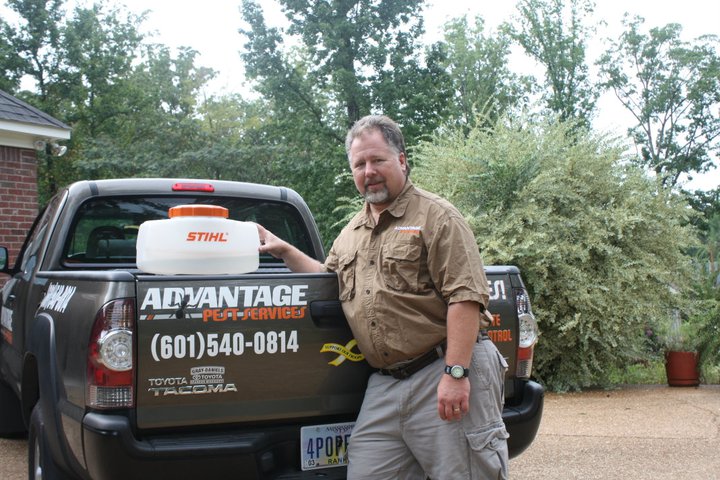
David is a Rankin County native. He has been in the pest control business since the 80s, working with national pest companies before founding Advantage Pest Services in Madison MS in April 2011. The reason he started his own company was simple: he wanted to bring a personal touch back to the work, and he wanted to be accountable to every property he services.
Every claim on this page traces back to a named primary source. The references we cite, document, and work from:
Service Areas
Rankin County seat, southeast of Madison
Madison County, Reservoir corridor
Hinds County, state capital
Rankin County, east of Jackson
Hinds County, west of Jackson
Hinds County, south of Jackson
Rankin County, south of Brandon
Related Field Guides