Flowood is the Rankin County suburb that sits where the Ross Barnett Reservoir spillway meets the Pearl River bottoms, ten to fifteen miles southeast of our Madison home base. The pest pressure here is what you would expect from a humid-subtropical city wrapped around a major bottomland waterway and a state-volume commercial corridor, with the added Formosan termite presence that defines Rankin County. We have run a Flowood route since 2011.
Flowood's residential corridor sits in USDA Hardiness Zone 8a, which is to say it sees humid summers in the upper nineties, mild winters that do not freeze the soil deep enough to interrupt subterranean termite activity, and the year-round insect pressure that defines central Mississippi. Inside city limits, your home is most likely between ten and forty years old, set on a lot that either backs up to the Pearl River bottoms or sits a short drive from the Lakeland Drive commercial spine, and pressured by the same six species that define every Rankin County property: cockroaches, mosquitoes, spiders, ants, wasps, and termites. Add to that the rodent factors that come with proximity to a high-volume commercial corridor.
Advantage Pest Services has worked Flowood since 2011. We are based in Madison, about twelve miles northwest by way of I-55 South and the Lakeland Drive connector. Our Flowood route is regular, not on-demand. Most calls are scheduled inside a week. If your address is in ZIP code 39232, we serve you. If you live on the edges of Flowood where the addresses bleed into adjacent Rankin County ZIPs, call 601-540-0814 and we will confirm.
We treat the full residential pest pressure of central Mississippi. Flowood's ecological position, wrapped around the Pearl River bottoms on the east, the Reservoir spillway on the north, and the Lakeland Drive commercial corridor through the middle, shapes which species you actually see, and when. Termites and Formosan subterranean colonies are the structural concern, and they are amplified by the bottomland soil. Mosquitoes peak in July and August alongside the West Nile vector window, and the spillway extends that window on both ends. Fire ants build through spring and fall. Paper wasps colonize the eaves of shaded homes from April through October. Cockroach and rodent pressure runs heavier on properties within a half-mile of the Lakeland Drive corridor.
Each of the six species below has a dedicated treatment page with the full anatomy, the regional pressure profile, and the treatment approach. Click any to read more.
Field Guide · Flowood MS Pest Pressure
Six species we identify, evaluate, and resolve year-round across every neighborhood in Flowood city limits. Click any specimen to read its dedicated page.

Periplaneta americana
Resident in warm, humid environments: kitchens, basements, drains.

Aedes albopictus
Daytime biter; carrier of West Nile and EEE in the Southeast.

Loxosceles reclusa
Hides in storage. Bite is medically significant; identification matters.

Solenopsis invicta
Aggressive mound-builder. Damages lawns, equipment, and outdoor life.

Polistes spp.
Builds umbrella-shaped nests under eaves. Defensive of the colony.

Coptotermes formosanus
The Southeast's most destructive termite. Call us if you suspect activity.
Flowood's commercial corridor is one of the densest in central Mississippi. The Lakeland Drive spine runs the length of the city and is lined with medical centers, offices, and retail anchors like the Bass Pro Shops at Dogwood. The corridor continues west into adjacent Jackson where additional regional draws sit just outside Flowood city limits, including the state-chartered Mississippi Sports Hall of Fame and Museum at 1152 Lakeland Drive in Jackson. Healthcare facilities, schools, and office properties along the corridor carry pest pressure that residential treatment is not built to handle. We service commercial Flowood properties under the same MDAC license categories that cover homes. The full commercial program is documented on the commercial pest control page.
Every Flowood property starts with an evaluation. We walk the inside and the outside, including crawl spaces and accessible attic areas, and we identify any pests present along with the entry points and conditions feeding them. We document what we find and write a treatment plan with pricing. There is no obligation to sign for service. If we find nothing that warrants treatment, we tell you so. The point of the evaluation is the evaluation, not the upsell.
For ongoing customers, our standard residential plan is quarterly. Four visits a year, each addressing interior, perimeter, and exterior harborage in the cadence the property actually needs. Termite inspection, mosquito service, and high-pressure additions (a fresh fire ant mound, a paper wasp nest under the eave, a rodent intrusion off the commercial corridor) can be added without re-quoting the plan.
Pest control in Mississippi is regulated by the Mississippi Department of Agriculture and Commerce, Bureau of Plant Industry under Mississippi Code Title 69, Chapters 19 and 23. Our license categories cover General Pest and Rodent (GRC) and Mosquito and Biting Fly (MBF). Licenses are renewed on a three-year cycle, and every technician carries a current MDAC-issued identification card. You can ask to see it on any visit.
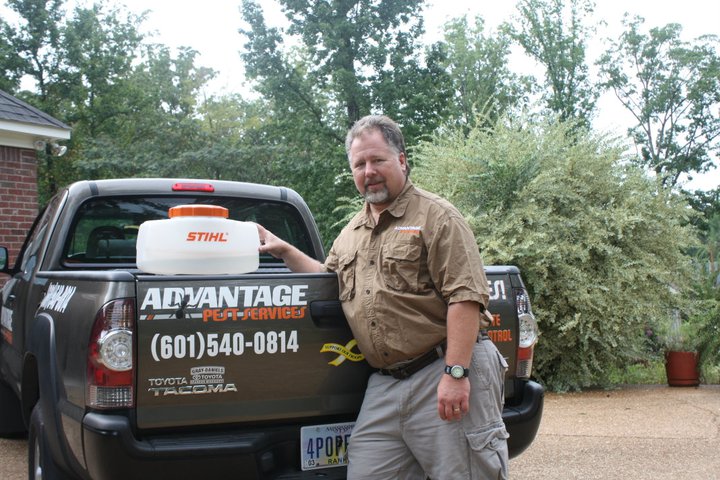
The practical accountability is local. Advantage Pest Services has operated in Madison since 2011. David McNeece, the owner, has been in the pest control business since the early 1980s and lives in the same Rankin County community he services. There is no regional call center between you and the work. If something isn't right, you talk to David.
Why Trust Advantage Pest Services
David is a Rankin County native. He has been in the pest control business since the 80s, working with national pest companies before founding Advantage Pest Services in Madison MS in April 2011. The reason he started his own company was simple: he wanted to bring a personal touch back to the work, and he wanted to be accountable to every property he services.
Flowood's residential map is shaped less by named subdivisions and more by ecological position. The Pearl River bottoms corridor along the eastern boundary is the city's oldest residential zone, set against the cypress and sweetgum bottomland forest that defined the area's early timber and industrial economy. The northern edge of Flowood runs up against the Ross Barnett Reservoir spillway, where residential developments have grown into the spillway corridor since the 1980s. The middle of the city is organized around the Lakeland Drive commercial spine, with residential pockets tucked behind the retail and office frontage. The Refuge Golf Course area on the southern edge anchors a third residential cluster.
Flowood is a young city by Mississippi standards. A delegation from Flowood petitioned Governor Fielding L. Wright to incorporate the community in 1950; despite opposition, the incorporation was upheld by the Mississippi Supreme Court in 1953. The Pearl River bottomland that defines the city's eastern boundary, the same bottomland forest that supported the area's early timber economy, still shapes Flowood's pest ecology today. The civic and commercial inventory inside city limits includes the Refuge Golf Course and Resort, the Bass Pro Shops at Dogwood retail node, and the medical and hospitality corridor that runs alongside the commercial spine. We serve the residential corridor first, but the commercial side is part of the same local accountability.
Most Flowood families fall inside the Rankin County School District, which serves all of Rankin County and operates the schools that feed Flowood's residential corridor. The District covers the schools themselves under separate pest protocols from the residential treatment we provide.
The ecology around Flowood is what drives the pest calendar. USDA Zone 8a humid subtropical means winter low averages near 37°F (mild enough that subterranean termite foraging continues year-round on warmer ground) and summer high averages in the low nineties with seventy-five percent humidity. The Pearl River bottoms run directly along the eastern boundary, and the Ross Barnett Reservoir spillway sits at the northern edge of the city. That combination, a major bottomland river and the discharge of the largest lake in central Mississippi, makes Flowood one of the strongest mosquito amplifiers in the region. The Mississippi State Department of Health vector control program tracks this corridor for West Nile virus and related arboviruses.
Flowood soil reflects the bottomland position: moist, organic alluvium along the Pearl River edge, transitioning to better drained Ultisols on the ridge sections where most of the residential development sits. The bottomland forest itself, dominated by bald cypress and sweetgum, is exactly the kind of decaying-wood substrate that supports the Formosan subterranean termite. That is the structural pressure homeowners on the eastern side of Flowood need to plan around.
The Lakeland Drive corridor adds a second, very different ecology to the picture. Commercial density (medical centers, offices, retail anchors) concentrates rodent activity around dumpsters and loading docks. Residences within a half-mile of the corridor see secondary pressure, and the treatment plans for those homes weight the perimeter program accordingly.
Every claim on this page traces back to a named primary source. The references we cite, document, and work from across Flowood and the Rankin County service area:
Flowood Service Area
From our Madison home base, our technicians work Flowood on a regular route. Most Flowood properties can be evaluated within a few days of your first call. If you are unsure whether your address is in our service area, ring 601-540-0814 and we will tell you.
Get driving directionsCities in Our Corridor
Drill down by pest
Field Survey · 2026
Pick up the phone. We'll talk through what you're seeing, ask a few questions about the home and the property, and figure out together whether an on-site evaluation is the right next step. No forms. No high-pressure sales.